NEW RESEARCH HIGHLIGHTS CONCERNS ABOUT BUTTERFLIES IN A CHANGING WORLD
SCIENTISTS URGE THE PUBLIC AND POLICY MAKERS TO HELP INTENSIFY EFFORTS TO MONITOR BUTTERFLY POPULATIONS WORLDWIDE, ESPECIALLY IN BIODIVERSE TROPICAL REGIONS, TO ASSESS EXTINCTION RISKS, ENSURE LONG-TERM SURVIVAL OF SPECIES, AND INFORM POLICY MAKERS WITH RELIABLE DATA TO BALANCE HUMAN DEVELOPMENT WITH CONSERVATION EFFORTS AND CLIMATE ADAPTATION
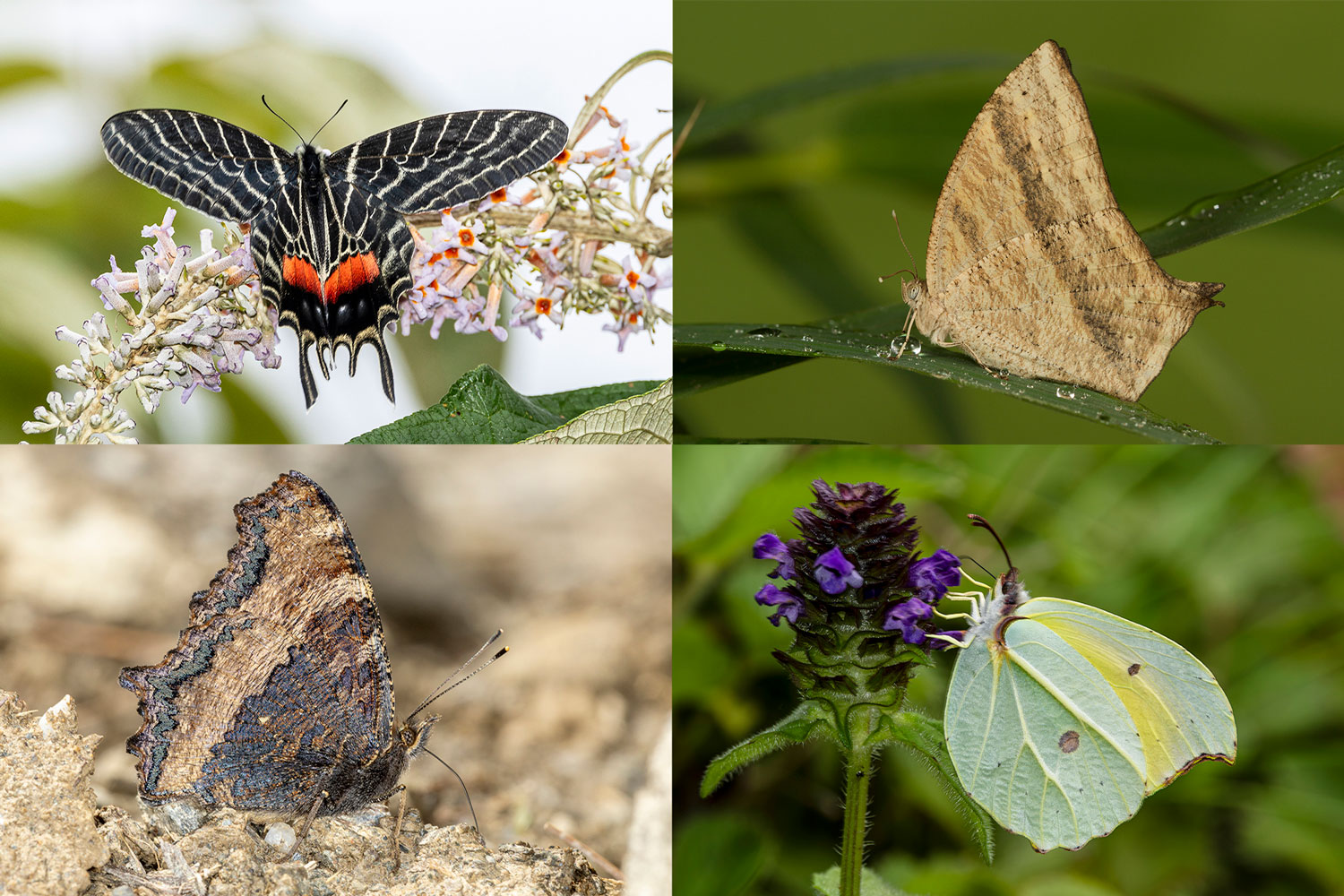
A sample of Indian species that are vulnerable to negative impacts of changes in habitat conditions and climate, that exposes them to extinction risk (clockwise from top-left): (a) Mystical Bhutan Glory (Bhutanitis ludlowi), (b) Travancore Evening Brown (Parantirrhoea marshalli), (c) Orange Brimstone (Gonepteryx amintha), and (d) Large Tortoiseshell (Nymphalis xanthomelas). These species are dependent on narrowly defined, elevationally constrained distributional ranges, climatic envelopes, and habitat specialisations, and contained in already fragmented populations. Photographs: Krushnamegh Kunte.
Three major scientific papers published this year converge on coherent but uncomfortable conclusions: butterflies, among the best-studied and most-loved insects on earth, are shifting where they live, declining in many of the places where they exist, and remain almost entirely unmonitored across the tropical countries that hold most of the world's butterfly diversity, including India, leaving a gaping blind spot in conserving them.
Taken together, the three studies—a first-of-its-kind “Global Butterfly Index” published in Conservation Letters, a global range-shift analysis published in Nature Ecology & Evolution, and a strategic framework for conserving tropical insects published in BioScience — represent one of the largest coordinated efforts yet to understand how butterflies are responding to habitat loss and climate change, and expose how little of that picture comes from long-term studies from the tropics.
A Global Butterfly Index That Highlights a Tropical Blind Spot
The first study published in Conservation Letters, which was led by Dr. David Roy and co-authored by members of the Indian Foundation for Butterflies Trust and the Bengaluru Butterfly Club, attempted something no one had done before: building a butterfly equivalent of the Living Planet Index, the metric long used to track vertebrate population trends worldwide. Drawing on over 45,000 population time series covering 1,055 species from 3,636 locations in 37 countries, the team calculated an average 24% decline in monitored butterfly populations since 1995 — with significant declines in North America and some declines in Europe.
The catch, once again, is geography. The vast majority of the underlying data comes from Europe and North America, where standardized, volunteer-driven monitoring schemes have run for decades. The rest of the world — including the tropics, where most butterfly diversity actually occurs — remains so undersampled that the trend estimate for those regions carries considerable uncertainty. As the authors put it, without robust monitoring, it will be difficult to assess the effectiveness of management actions implemented to protect pollinators and meet global biodiversity conservation targets, to many of which India is a signatory.
Butterflies on the Move
The Nature Ecology & Evolution study, led by Dr. Shawan Chowdhury and involving contributions from Dr. Krushnamegh Kunte of the National Centre for Biological Sciences (NCBS), Bengaluru, analysed documented range-shift records of 1,758 butterfly species across 105 countries — slightly less than 10% of all known butterfly species — by combining published literature in 15 languages with assessments from 68 butterfly experts worldwide. Most species studied (80%) had expanded their ranges, and the large majority of these shifts (79%) were linked to climate change and extreme weather. But more than a quarter of species had also lost part of their range, and nearly a quarter showed shifts along elevational gradients — species moving upslope or downslope as temperatures changed.
The study found that horizontal range expansions dominated in tropical countries, while range contractions and elevational shifts were reported almost exclusively from Europe and North America — not because tropical butterflies are more resilient, the authors note, but because almost no one is watching them closely enough to detect contractions or elevational movement in the first place. Data gaps remain severe in many of the tropical countries, making informed decisions about conservation action considerably more difficult.
Closing the Gap: The Case for India
This is precisely the data gap that the Indian Butterfly Monitoring Scheme (iBMS; https://www.ibms-network.in), of which the IFBT Trust is a leading member, was built to close. Both the Conservation Letters and BioScience papers single out iBMS as one of a handful of monitoring programmes now taking root in tropical, historically data-deficient countries—alongside similar efforts in Brazil and Malaysia. This is precisely the kind of standardised, long-term, structured population monitoring that opportunistic photographs and one-off checklists cannot replace.
iBMS matters for reasons that go well beyond filling in a map. India is one of the top biodiverse countries that also has the largest human population, much of it still poor but upwardly mobile. This combination creates a challenge to design any human development and poverty alleviation efforts that do not utterly destroy the environment and biodiversity. The poor and dispossessed people still rely heavily and directly on natural resources, and their well-being depends disproportionately much more on the clean environment, water and air, and basic agricultural productivity, than economically well-off sections of the society do. Thus, human development, environmental preservation and biodiversity conservation should not be seen as disparate needs, but should require a coherent policy that address these issues together.
This is where development and economic policies should be informed, among other obvious factors, by rigorous data analysis of climate and environmental trends and biodiversity conservation priorities. iBMS generates, curates and analyses long-term data on butterfly diversity and population trends as a reflection and indication of larger trends in biodiversity. The iBMS butterfly data help scientists distinguish a genuine population decline from ordinary seasonal, yearly and random fluctuations in numbers. Such a systematic, standardised approach has underpinned butterfly conservation policy in Europe for decades, although the butterfly diversity in Europe is a fraction of the diversity found in India and other tropical, developing countries. By developing and employing a standardised sampling method that is suitable for Indian landscapes and butterfly diversity, rather than blindly copying different methods from species-poor and highly seasonal temperate regions, iBMS set a high standard and rigour for data collection and nation-wide comparison of butterfly trends. It draws on citizen-naturalists walking the same routes month after month, building both a long-term dataset and a community of people invested in the outcome. Because short-lived butterflies respond very quickly to changes in vegetation, temperature, and land use, the trends iBMS uncovers function as an early warning system for much broader ecological change. This is the kind of ecological and environmental signal that can reach policymakers years before a crisis becomes visible in slower-moving indicators such as long-lived large animals, or some environmental parameters. Biodiversity and environmental indicators such as butterfly populations may reveal impending crises within months-to-few years before conditions become obviously bad enough to be captured by other indicators. At the other end of the problem, if good policies are implemented that restore biodiversity and the environment, butterfly populations are capable of rebounding rapidly, showing early signs that the interventions implemented are successful.
A Message for a Warming, Developing World
Speaking about the significance of this growing body of data-rich scientific research, Dr. Kunte, who is the founder and coordinator of iBMS and a co-author of all three research papers, framed the stakes in terms particularly relevant to India:
“Butterflies are telling us something important and urgent, and we are only now building the means to listen properly. In a country such as India, where we are trying to lift millions of people out of poverty while also protecting some of the most biodiverse landscapes on the planet, we cannot afford to make that trade-off blindly or with poor information. Every butterfly walk made for iBMS gives us real evidence — not guesswork — about which habitats are holding steady, which species and populations are sliding toward trouble, and where and how our climate adaptation and development planning need to be balanced. Butterfly monitoring is not a luxury for wealthy countries with time to spare; it is the kind of low-cost, high-return science that a developing country needs the most, because it lets us target conservation and development investments where they will actually work. This is better than reacting once the damage is already done, whether it is for humans or biodiversity. If we get this right, India will not just be catching up to global butterfly science — we will be showing the rest of the tropical world how it is done.”
What Comes Next
The three research papers arrive at a similar prescription: expand standardised butterfly monitoring in the tropics, integrate citizen science with structured long-term data collection, and build that evidence directly into conservation planning and protected-area design rather than treating insect biodiversity as an afterthought. With the majority of insect species inadequately represented in the world's protected areas, and most tropical countries still in what researchers call the “taxonomic discovery phase” for their insect faunas, the window for building this evidence base—while landscapes are still changing rather than already transformed—is narrowing.
For India, with its extraordinary butterfly diversity and its own fast-moving development pressures, that makes programmes like iBMS not just scientifically valuable, but genuinely urgent.
Citations of the research papers:
1. Riva et al. 2026. Addressing gaps in butterfly population monitoring to catalyze global insect conservation. Conservation Letters, 19:e70037. DOI: https://doi.org/10.1111/con4.70037
2. Chowdhury et al. 2026. Extensive climate-induced range shifts in butterflies across the globe. Nature Ecology & Evolution. DOI: https://doi.org/10.1038/s41559-026-03117-y
3. Chowdhury et al. 2026. A framework for the strategic conservation of tropical insects. BioScience, biag136. DOI: https://doi.org/10.1093/biosci/biag136